Why Slowing Down Might Be the Best Thing for Cosnova to Do with AI in Marketing

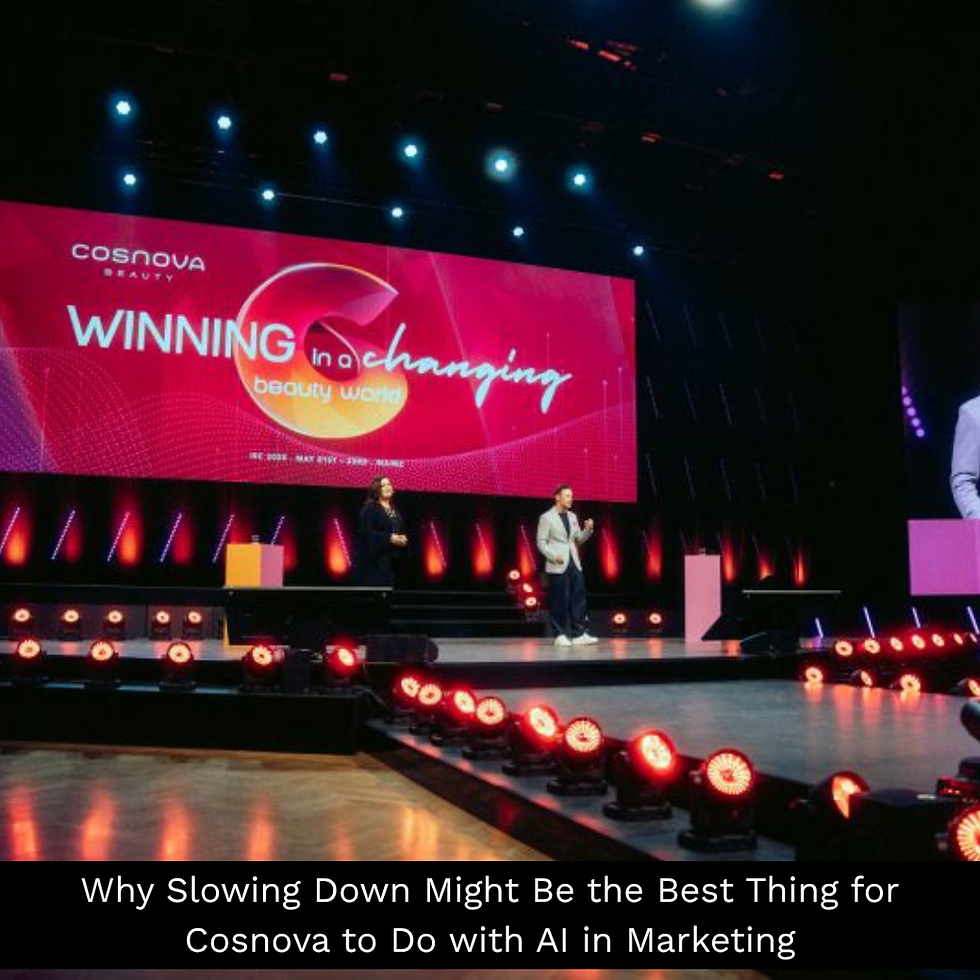
Because every marketing leader is being told to "do something with AI," speed has become the default strategy. Companies are rushing to add generative AI to their workflows, automate content creation, and find ways to be more efficient, often expecting results right away.
But one beauty brand is taking a different approach.
Cosnova, the company behind Essence and Catrice, has been testing AI in its marketing department for the past 18 months. Instead of rushing adoption, it chose a slower, more deliberate path—testing, learning, and refining before scaling.
The result is a playbook that challenges how companies think about AI in marketing.
The Need to Quickly Adopt AI
Executives across industries want AI to deliver quick results. Marketing teams are expected to:
Run campaigns faster
Reduce costs
Increase output using generative tools
Cosnova faced the same pressure.
But instead of jumping straight into AI implementation, the company focused on understanding where AI truly adds value—and where it doesn’t. The key insight: clarity matters more than speed.
This mindset shaped everything that followed.
15 Tests, 7 Winners
Over 18 months, Cosnova ran 15 different AI pilots across its marketing operations. These experiments covered multiple use cases:
Image generation
Text generation
Video production
Process automation
But fewer than half of these pilots succeeded.
Only seven passed the company’s internal evaluation criteria.
Each pilot was assessed on three key dimensions:
Technical feasibility – Does the output match or exceed human quality?
Organizational viability – Can it realistically integrate into workflows?
Brand fit – Does it align with the brand’s identity?
This structured approach ensured AI adoption was driven by results—not hype.
When AI Fails (And Why It Matters)
One of the most important lessons from Cosnova’s journey is that not all AI use cases are worth pursuing—even if they work technically.
For example:
Fully AI-generated photoshoots worked—but cost as much as traditional ones
AI-modified model appearances were feasible—but rejected on ethical grounds
These decisions reinforce a critical principle:
Just because AI can do something doesn’t mean a brand should.
The Difficulty of Getting Beauty Right
Unlike fashion, where AI can easily generate simple items, the beauty industry presents unique challenges.
Cosnova found that AI often struggled with:
Complex textures
Subtle finishes
Accurate color representation
For instance, a nail polish with a slight shimmer could be misrepresented by AI—altering its appearance.
In an industry where product accuracy is essential, even small inconsistencies can reduce consumer trust.
For Cosnova, authenticity is non-negotiable.
Digital Twins: The Breakthrough
One of the most successful outcomes from Cosnova’s AI experiments was the development of digital twins.
These are highly accurate digital replicas of physical products designed to mirror real-world appearance.
Key highlights:
Achieved 96% accuracy in the first iteration
Tested with 2,000 consumers
Many users couldn’t distinguish between real and AI-generated images
Some even preferred the AI-generated visuals
This unlocks major advantages:
Faster content creation for social media and e-commerce
Reduced reliance on traditional photoshoots
Greater agility in responding to trends
For a brand that refreshes up to 50% of its product range annually, this speed is critical.
Balancing Quick Wins and Long-Term Bets
Cosnova didn’t treat all AI initiatives equally. Instead, it balanced:
Short-Term Wins
AI-assisted video editing
Up to 70% reduction in production time
Long-Term Investments
Digital twins
Data infrastructure
Interestingly, the company reframed productivity gains:
Instead of asking “How do we produce more?” They asked “How do we create better?”
The focus shifted from volume to creativity and strategy.
The Data Problem: AI Needs Strong Inputs
Like many companies, Cosnova faced challenges with data readiness.
AI systems depend heavily on structured, high-quality data. Without it, outputs suffer.
Cosnova addressed this by leveraging:
Product data (ingredients, packaging, claims, benefits)
Internal systems to organize information
“Knowledge graphs” to connect fragmented data
Key takeaway:
You don’t need perfect data to start—but you need a solid foundation.
A Non-Negotiable Rule: Ethical AI
In an industry often criticized for unrealistic standards, Cosnova has taken a strong stance on ethical AI.
The company avoids:
Creating hyper-realistic human features
Misleading product representations
Its approach includes:
Transparency in AI-generated content
Maintaining consumer trust
Responsible use of technology
This creates a clear boundary between reality and manipulation.
AI as a Partner, Not a Substitute
Cosnova’s philosophy is clear: AI is not a replacement for humans.
Instead, it is treated as a co-worker that:
Handles repetitive tasks
Frees up time for creative thinking
Enables better strategic decisions
This people-first mindset has been central to its success.
The Most Important Lesson for Marketers
Cosnova’s journey offers a strong counterpoint to the AI hype cycle.
While many brands focus on speed and scale, Cosnova demonstrates:
Not every AI use case is valuable
Testing matters more than rushing
Brand integrity should guide decisions
People should come before technology
Its guiding principle is simple:
“Put people first, not technology.”
Conclusion: Going Slower to Go Faster
Most companies are racing to adopt AI as quickly as possible.
Cosnova chose a different path—one rooted in:
Experimentation
Discipline
Strategic thinking
By slowing down, it may have discovered a faster route to meaningful AI adoption.
Because the goal isn’t just to use AI.
It’s to use it in a way that works—for the business, the brand, and the people behind it.


Comments